Side-road crossings.
Problems

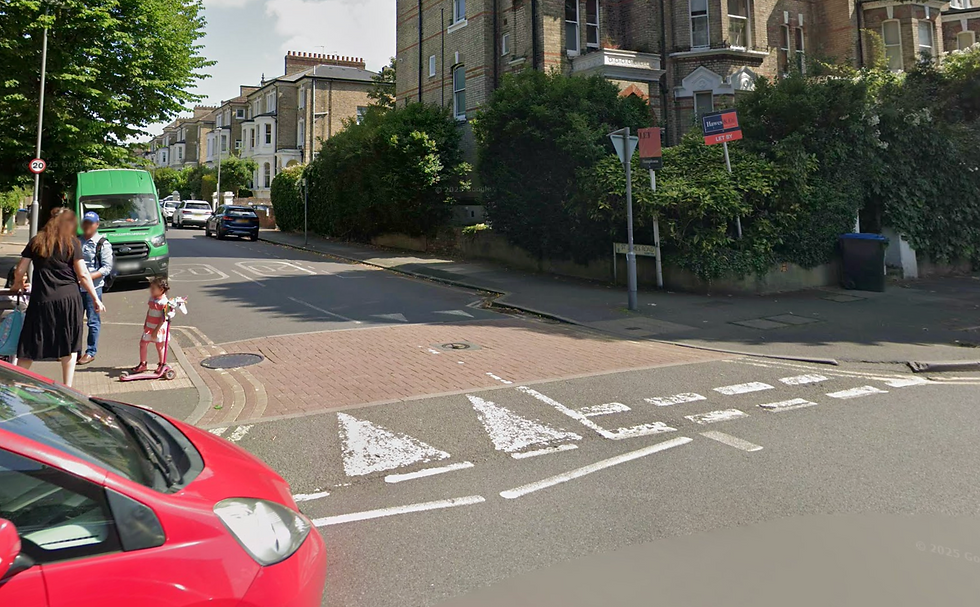
This mother and her children obviously thought they were on a pavement across the road junction. The driver did not.
Image - Living Streets
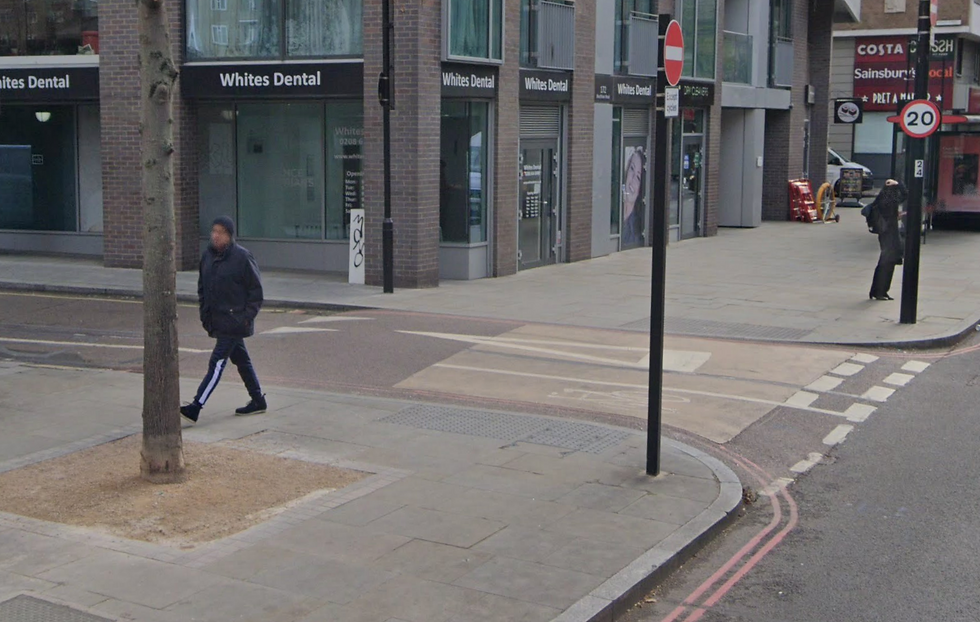
Messages intended to instruct and guide road users are:
1. Tactile paving. Warning to visually impaired pedestrians that they are about to walk into a road
2. Kerb level with raised road "table" at crossing point to help wheel chair users
3. Dashed line marks the entrance from main road to a side-road
4. Triangles warning drivers of raised "table" obstruction in road
5. Triangle warning cyclists of raised "table" obstruction in road
6. Contra-flow cycle lane
7. Give way triangle for cycles entering main road
8. Additional give way double dashed line for cycles
9. Zigzag lines at adjacent pedestrian crossing on main road

At this side-road crossing, unless there is little traffic, vulnerable pedestrians will have difficulty to cross. All the road markings are to help drivers and cyclists, not pedestrians
The issue has been thoroughly reviewed by Robert Weetman in his report for Living Streets, October 2023 "Inclusive design at continuous footways"
The report's main conclusions emphasise the points often raised in technical discussions about the design of crossings at side-road junctions, including:
The lack of design standardisation leading to nationwide confusion about who exactly has priority where;
The distinction between the appearance of the surface of the crossing and the adjacent road surface is often blurred.
Many crossing places can seem to drivers to be merely the result of road-works rather than a place where they should give way to pedestrians;
Even at places where there has been an attempt to help pedestrians, such as a continuous raised pavement, or as in the example here , where the road surface is raised to pavement level, it is treated by engineers as a road hump.
All the white lines and other official road markings are put in place to reduce the inconvenience of drivers, rather than as a device to reduce vehicle speeds to that of a pedestrian.
All this is recognised by the Department for Transport's 2026 report Better Connected. "Pavements are often uneven, cluttered or have too few safe crossing points, discouraging even short walking or wheeling trips and creating barriers to accessing public transport."
The Highway Code (Rule H2) clearly instructs drivers and cyclists that "At a junction you should give way to pedestrians crossing or waiting to cross a road into which or from which you are turning."
But the places where people are encouraged to cross by tactile paving and possibly a specially raised stretch of road, with also a change of surface colour and texture, are not understood by drivers and cyclists to be where they should give way to allow pedestrians to cross.